
“Kingdom in the Sky” in Africa
Past, present and future of the Kingdom of Lesotho
Introduction
“By 2020, Lesotho shall be a stable democracy, united, prosperous nation at peace with itself and its neighbours. It shall have a healthy and well developed human resource base. Its economy will be strong, its environment well managed and its technology well established.” This is the main message of the National Vision Document of Lesotho, “Vision 2020”. Since being independent, main problems of Lesotho have been creating consensus in society and establishing legitimacy for the government. At the moment these are only long-term objectives, they cannot be achieved without decreasing dependency and launching economic development.
Due to its geographic features and isolation, ethnic and tribal cleansing, wars bringing most African countries misery, and continuous political instability have stayed away from the Kingdom of Lesotho. Though landlocked by the Republic of South Africa, the bordering range of mountains still ensures protection for the country.
Throughout Lesotho, ancient culture and fast modernization blend together everywhere. Tourists travelling through from South Africa of arriving by plane gain pleasant experiences of good atmosphere, several sights to see, and numerous entertainment and leisure activities await people with any kind of needs.
Lesotho’s exact location is not very well known in Hungary – neither in other parts of the world. The country – commonly referred to as “Switzerland of Africa”, “Kingdom in the Sky in Africa” or “Empire of the Clouds” because of its high mountains – is indeed a small monarchy situated in the southern corner of Africa, embedded as an enclave in the Republic of South Africa. Its boundaries run with those of KwaZulu-Natal to the east, Eastern Cape to the south, and the Free State to the north and west. Its size is comparable with Belgium or with state Minnesota in the USA, the number of its residents does not amount to 2 million.
Official name of the country is: Kingdom of Lesotho, ‘Muso Oa Lesotho in Sesotho language. The name Lesotho roughly translates into “the land of the people who speak Sesotho”. Formerly, till its independency, it was known as Basutoland. As many other African countries, Lesotho is a member of the Commonwealth of Nations. The country is a constitutional monarchy, its capital is Maseru.
Demographics and Education
Lesotho has a population of approximately 1.87 million. Ethnic groups of the country are: Sotho 85% (its largest subgroup is Kwena), Natal (North) Nguni and Cape (South) Nguni (Thembu) 14%, Asians, Europeans and other 1%.
Majority of the population, 75% is Christian (Roman Catholic 39%, Evangelical 36%), and 25% follow tribal religions. Official language of the country is Sesotho (Southern Soto), an independent language of the Bantu family. English and Xhosa are also used, and there are some who speak Ndebele or Swazi as well.
The population is well-educated, literate and skilled. Lesotho has the highest rate of literacy in Africa, 88% of woman and 74% of man are able to read and write. The country has its own university campus (the “National University of Lesotho” is found in the town Roma), being recognized in Africa, and internationally as well, on account of some of its departments.
Several schools have been founded by Christian missionaries arriving to the country in the 19th century, and since English was obligatory due to the country being under British protectorate, majority of the population still speaks English well.
Within the frames of government program “Standard One”, primary education is free since 2000. 89% of woman and 83% of man attends to primary schools, but only 18-27% of the population goes to secondary school, mostly due to tuition fees.
Primary and secondary education is available throughout the whole country, a number of international schools are found in Maseru. As a cosmopolitan country Lesotho has children of all nationalities, and these are able to receive secondary education in Maseru up to entrance level for universities or returning to their home countries. The principal goal of higher education in Lesotho is continuing basic vocational education, thus creating skilled workforce. The basic language of education in primary school is Sesotho, but English is used in the upper classes of primary schools and in secondary schools. In contrast with many other developing countries, female participation in education in Lesotho has been much higher than that of males.
Much has been achieved in the past years, with further high schools completed, vocational and technical centers expanded, and equipment procured for workshops and libraries. The program of construction and furnishing of schools, laboratories, and resource centers is ongoing at all levels.
The growth of population has stopped by now, the average age is only 33 years. The level of unemployment is high, at least 40%, although many households produces basic foods for themselves by subsistence farming. Lesotho people, called Basotho are generally poor, but famous for leading an active, hard-working life.
HIV/AIDS infection in the Kingdom
Fears from AIDS are confirmed: the proportion of AIDS-infected people in Lesotho was 32% in 2006 even according to government statistics. One of the greatest challenges and an utmost danger of our days is the spread of HIV and AIDS-infection in the kingdom and neighbouring countries. Since these countries – except for the Republic of South Africa – are small-sized and sparsely populated, they are more sensitive to any demographic fluctuation. The virus hit the sub-Saharan region in several waves in the past three decades, affecting a population of four generations. With respect to mortality, Lesotho – after Swaziland – is tragically second amongst South African states, and as for life expectancy of infants, it is at the last place. Also, comparing annual growth rates in population, with 0,08% the country is at the bottom of the list. Consequently, the unofficial average age is around 30 years maximum. Furthermore, illness is not only a health-issue, but a social matter as well. People, of whom infection becomes public, will be isolated. The opinion of the church about any protection also contributes to the fast spread of the virus, mostly amongst Roman Catholics. Currently there are two Hungarian organizations who try to give advices and see prospective in AIDS-research and supply of medicine. A mixture of factors are to blame for this situation such as the economic structure of the country based on daily commute of adult population, fully interoperable borders, the often uncontrolled migration, the African “miner-culture”, prostitution as informal “economic activity”, and the lack of appropriate government measures. However it should be noted, that the first HIV-infected person to be registered in Lesotho was not a local, but a South African citizen. The spread of HIV/AIDS is a matter of national security. It does not discriminate by social status, wealth or age. It strikes the army just as it strikes active adult population being an economic and demographic power. A shock of the main state-forming power, the population, together with the uncertainty, the drastic drop in life expectancy might cause a crisis in the whole state. Without permanent and constant population the state loses its grounds, its source of legitimacy and its subjects of authority.
History of Lesotho
The country commonly referred to as “Switzerland of Africa” has been inhabited by bushman’s till the beginning of the 19th century. After the raids of Zulus, from 1818 I. Moshoeshoe consolidated various groupings of inhabitants and Bantu tribes as Basotho: they occupied lowlands in 1824, and gradually took over the mountains as well, establishing the headquarters of their realm on the well-defendable Thaba-Bosiun. Basothos fought desperate wars against advancing Boers: the wars in 1858 and 1865 weakened them even more, causing the loss of western lowlands of Orange Free State. Moshoeshoe – hoping to receive British assistance against Boers – appealed for British protection in Cape Town in 1868.
As a result, the country became a British protectorate under the name of Basutoland, first it was annexed to Cape Colony between 1871 and 1884, and British rules were resumed in 1884. The British government enabled a new constitution in 1958, and the first elections were held in 1960. After a new government and new constitution in 1965, the country attained full independence on the 4th October 1966 as the Kingdom of Lesotho, an autonomous constitutional monarchy, member of the Commonwealth Nations. Since then, this is the most important national holiday of the country.
On the 1965 election preceding independency, the interests of Apartheid-ruled Pretoria and power relations required the victory of the conservative Basotho National Party supported by South Africa, under the leadership of Leabua Jonathan, great-grandson of Moshoeshoe. Bereng Seeiso ascended the throne as Moshoeshoe II.
The unsuccessful consensus policies and “rand-diplomacy” of the South African Apartheid-regime – becoming highly unpopular amongst independent states – was replaced by the concept of “total strategy”. The strategy meant that the government of the Republic of South Africa had authorized itself to execute secret or open military intervention in any African state south from the Equator, despite objections of the countries. From the middle of the 1970’s Lesotho aimed at separating from the South African regime and resisting South African influence efforts. Resistance was supported by direct and indirect backing of anti-Apartheid movements, hiding ANC-leaders and helping their families. Nevertheless its results were not always successful; occasionally leaders of ANC were liquidated by South African forces, in Lesotho as well.
At the same time, there has been a significant concentration process of powers, as a response to his defeat at the first free election in 1970, Prime Minister Jonathan came to power in a bloodless coup and started to build up his dictatorship.
Pretoria decided to support the Lesotho Liberation Army, a military wing of BCP opposing the Jonathan-dictatorship. The ever growing tension in internal and foreign affairs were further exacerbated by the 1986 border blockades and economic sanctions, leading to the weakening of the Jonathan-regime’s position and resulting in a military coup of the LLA. General Lekhanya, commander of the Lesotho Paramilitary Forces leading the coup, became leader of the Military Council of the government, and immediately banned any political activities in the country.
From the second half of the 1980’s on, the military regime received great domestic and international pressure towards democratic transformation. The government was apparently keen to change, and Lekhanya promised to restore order and civil government by 1992. Yet in the background he continued power concentration, Moshoeshoe was exiled, and his son Letsie was installed, but it caused crisis within the Military Council. Lekhanya was ousted in 1991 and replaced by Ramaema, and the democratically elected BCP ascended to power in 1993, with Ntsu Mokhehle becoming new prime minister of the kingdom. The new Lesotho government inherited an unstable country weakened by more than 20 years of dictatorship, where military, although not unified, gained a high degree of autonomy.
The government of Mokhehle did not have the right measures to handle the military’s pursuit of power. Therefore Letsie suspended Parliament, generating heavy protests within the country and internationally as well. The governing party was split by inner conflicts, Mokhelhe placed executive power into the hands of the Lesotho Congress for Democracy organization founded by himself, but the new government was not recognized internationally due to public frauds.
In spite of this, LCD won the 1998 elections, even with the heavy protest of the opposition. Soon initially peaceful demonstrations of the opposition converted into waves of violence, therefore reacting to the riot of the military the Lesotho government appealed for the intervention of South African forces in the autumn of 1998 to avoid forthcoming military coup and to settle the crisis. South African and Batswana troops putting down the mutiny stayed present in Lesotho as law enforcement unit till May 1999. Domestic settlement was difficult due to the reform of the voting system and accusations; however the mood calmed down later.
As a result of becoming democratic, the elections of 2002 were held based on the new system, resulting in the victory of LCD, although opposing parties gained many seats as well. Bethuel Pakalitha Mosisili appointed first in 1998 has been elected Prime Minister – and Minister of Defence and National Security – for another five year term in the elections of 2007.
The Structure of the Kingdom
The Kingdom of Lesotho is traditionally a matriarchy operating within democratic and constitutional frames, with independent Parliament, a woman as house of Parliament, with independent governing, and compared to African relations, a high number of women as ministers.
The head and leader of the state is King Letsie III. since 7th February 1996. The monarch is hereditary, but under the terms of the constitution which came into effect after the March 1993 election, the monarch is a "living symbol of national unity" with no executive or legislative powers, he only serves a ceremonial function.
At general elections the candidate of the party receiving the highest number of votes becomes prime minister. Present Prime Minister Bethuel Pakalitha Mosisili heads the government from 29th May 1998 on.
For administrative purposes, Lesotho is divided into 10 districts, which are: Berea, Butha-Buthe, Leribe, Mafeteng, Maseru, Mohales Hoek, Mokhotlong, Qacha's Nek, Quthing, Thaba-Tseka.
Principles of the constitutional monarchy
The present constitution of the country came into effect on 2nd April 1993. Lesotho is a constitutional monarchy; its Parliament has two chambers. Eligible voters are Lesotho citizens 18 years and older. The constitution also protects basic civil rights, including freedom of religion, assembly and the press.
The legislation of the country is based on English private law and Roman-Dutch law. Enactment is supervised by the High Court of Lesotho and the Court of Appeal, and legislation of International Court of Justice is accepted under reservations.
General elections and the parliament
Since the present constitution, general elections have been held four times in Lesotho. In 1993, the Basotho Congress Party (BCP) won the elections, on 23rd May 1998 the Lesotho Congress for Democracy (LCD) gained victory, and on 26th May 2002 and 17th February 2007, the results were in favour of the BCP again.
The Senate, the upper chamber of the bicameral Parliament consists of hereditary clans or chiefs and some elected statesmen (33 members – 22 principal chiefs and 11 nominated by the governing party). The National Assembly has 120 members, 80 in single-seat constituencies and 40 by proportional representation; representatives are elected for a five year term. Traditionally, the presence of tribal leaders indicated contact between government and working class (mainly miners). The underlying principle was to assure the legitimacy of the ruler through legitimate positions created by consensus and close connection with citizens. This implicit cooperation was the greatest force prohibiting mutinies against government. The next elections are going to be held in 2012. Currently the distribution of seats between parties: LCD 61, NIP 21, ABC 17, LWP 10, ACP 4, BNP 3, and other 4.
National Holidays
Since majority of the population is Christian, major holidays are related to this religion, such as Christmas and Easter. Also, the Ascension of Virgin Mary is an important day to celebrate. Naturally, state-related commemorations are also held, the most important are the commemoration day of the first king, Moshoeshoe (11th March), the birthday of the present King (17th July), and of course, the National Independence Day (4th October).
Map
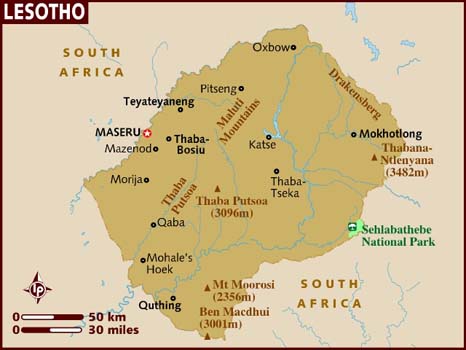
Kings of Lesotho
- 1965-1970
- II. Moshoeshoe
- 1970
- Leabua Jonathan
- 1970
- Mamoható Queen
- 1970-1990
- II. Moshoeshoe
- 1990
- Mamoható Queen
- 1990-1995
- III. Letsie
- 1995-1996
- II. Moshoeshoe
- 1996
- Mamohato Queen
- 1996-
- III. Letsie
More ..
©MMXVI. Medexponet Kft.
