
News
Gem Diamonds finds two high-quality stones at Letšeng
Africa-focused Gem Diamonds (LON: GEMD) said on Monday it had dug up two Type II white diamonds at its iconic Letšeng mine in Lesotho.
One of the roughs is a 245-carat Type II white diamond. The other, found on the same day, is a 102-carat stone, the company noted.
SIGN UP FOR THE PRECIOUS METALS DIGEST
Since acquiring the mine in 2006, Gem Diamonds has found five of the 20 largest white gem quality diamonds ever recovered, which makes Letšeng the world’s highest dollar per carat diamond mine.
At an average elevation of 3,100 metres (10,000 feet) above sea level, the operation is also one of the world’s highest diamond mines.
The company recently decided to focus production efforts exclusively on Letšeng by selling its Botswana subsidiary to Okwa Diamond for only $4 million.
The diamond market came to a standstill at the height of the covid-19 pandemic, increasing worries that oversupply could hurt the sector for years. But surging purchases by intermediaries who cut, polish and trade stones has all but wiped-out miners’ stockpiles, even as Russia’s Alrosa and its closest competitor, Anglo American’s De Beers, have hiked prices.
“Rough diamonds stocks at miners are at minimal levels as supply structurally dropped, but jeweller demand is strong in all the key markets,” Alrosa warned last week.
The investment arm of VTB Group, one of Russia’s largest banks, estimates that global rough diamond output was down 19% in 2020 to 112 million carats. It expects 2021 production to be little changed as the depletion of Rio Tinto’s Argyle mine has offset so far production pick-up at the two world’s largest diamond producers.
source: mining.com
Southern Africa: Former U.S. Presidents to Visit Lesotho
Three former presidents of the United States, Bill Clinton, George Walker Bush and Barrack Obama are due in the country in July for a policy dialogue which is expected to lead to the construction of a facility for the treatment of cancer patients in the country. The trio are expected to accompany their spouses, Hillary Clinton, Laura Bush and Michelle Obama to the conference which will hosted by the First Lady, 'Maesaiah Thabane.
This was revealed by the Minister of Health, Nkaku Kabi, in an interview with the Lesotho Times this week.
"The former USA presidents Mr Bush, Mr Clinton and Mr Obama will be here in July," Mr Kabi said.
"They have confirmed that they will accompany their wives to attend the first ladies' alliance conference which will be hosted by our First Lady, Ms Thabane." Mr Kabi said among other things, the July conference will discuss how Lesotho can establish a sustainable cancer centre. Mr Clinton is one of the key members of the Clinton Foundation governing board, and his wife also served as key member from 2013 to 2015. The non-governmental organisation works with strategic partners to confront public health crises such as cancer, HIV and AIDS, the opioid epidemic, heart disease, diabetes, childhood obesity and combating the effects of climate change through clean and renewable energy efforts. Ms Bush founded the Laura Bush Institute for Women's Health in 2007. The institute is positioned to develop research and educational programmes based on populations whose health issues are traditionally under-recognised or unknown such as rural populations, minorities and the elderly.
As the first lady, Ms Obama focused on social issues such as poverty, healthy living and education. She also focused on supporting military families, helping working women balance their careers and family lives.
Meanwhile, the First Lady's Public Relations Manager, Silas Monyatsi, would neither deny nor confirm the former USA presidents' visit.
"The minister is my superior and is privy to more important information than I am. Without contradicting what he said, the only issue I know is that the three former USA Presidents are expected to come with their spouses to attend the First Ladies' conference in July but I have not received confirmation of their attendance. I might not be aware that they have confirmed because as a servant I take my mandate from my superiors and have not received anything in that regard," Mr Monyatsi said. Mr Clinton has previously visited Lesotho in July 2005 where he officiated at the official opening of a pediatric HIV and AIDS clinic at Queen Elizabeth II Hospital in Maseru which was established with the help of the Clinton Foundation. He also reviewed the government's progress in the expansion of access to HIV and AIDS care and treatment after the Clinton Foundation helped in the launching of the public antiretroviral treatment program in 2004.
source: allafrica.com
How the Basotho blanket became the brand identity of a nation
Basotho blankets are unique. They are a cultural symbol, the brand identity of a nation, but always a practical and useful garment. They are beautiful but are meant to be worn, not displayed.
They are fascinatingly woven into the history of the Basotho nation, and are a perfect example of a colonial legacy adopted and transformed with greater meaning, not least the historic relationship between Britain and Lesotho.
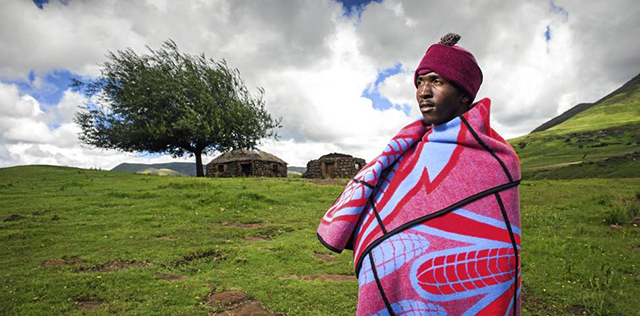
Legend has it that the first blanket was given to King Moshoeshoe I in 1860 by a trader, possibly a man called Howel. The king liked it and took to wearing it around his shoulders as a kaross. His subjects followed suit. Traders had been selling blankets across southern Africa much earlier, but Moshoeshoe's adoption of one gave them royal approval. When in 1867 Moshoeshoe asked the British for protection against the encroaching settlers, he described it as Queen Victoria "spreading her blanket" of protection over the Basotho nation. In 1868 the then Basutoland became a British protectorate (not a colony) and remained that for 98 years.
Hides and skins traditionally tanned and worn by the indigenous tribes of southern Africa became increasingly hard to find in the second half of the 19th century, and this was exacerbated by the rinderpest of the 1890s, which wiped out more than five million cattle and unknown numbers of wild animals south of the Zambezi alone. Blankets replaced the karosses, and, maybe because of their cold climate, the Basotho took to them like no other group. A lovely myth has it that on a visit to Basutoland for her diamond jubilee in 1897 Queen Victoria presented King Lerotholi Letsie with a blanket. But in fact Victoria never set foot in Africa or any of her many colonies: by 1897 the old queen would or could not even get out of her carriage for the jubilee service at St Paul's in London.
But Victoria's diamond jubilee that year did mark the release of the "Victoria England" brand of the blankets, which became hugely popular and remains so to this day. Before he adopted the blanket Moshoeshoe wore ceremonial leopard skins, which is why one of the first designs in the Victoria England range was the "Skin".
Early traders also gave or sold blankets to workers, including Basotho, in Kimberley after the diamond rush. The Fraser brothers Donald and Douglas, sons of a wool merchant in Ipswich in England, set up a store in Liphiring in Basutoland in 1877 to trade in blankets and other goods. By 1899 they had 12 stores and Frasers Ltd became part of the country's history.
The first blankets were manufactured by Wormald and Walker blanket mills in Yorkshire and exported to Frasers and other traders. When that company folded, production was taken over by AW Hainsworth, which still holds the rights to the Victoria England brand.
AW Hainsworth also made the Hudson's Bay point blanket for the Hudson's Bay Company trading in Canada and the US. That blanket became identified with the Navaho Indians, but perhaps not as closely as the Basotho blanket is with Lesotho.
The point blanket (named for short stripes which indicated the size while folded) had large stripes on a white background, but in Basotho blankets the accepted explanation of the vertical 1cm "pinstripes", which became an essential part of every design, was that they started with a weaving error and people liked it.
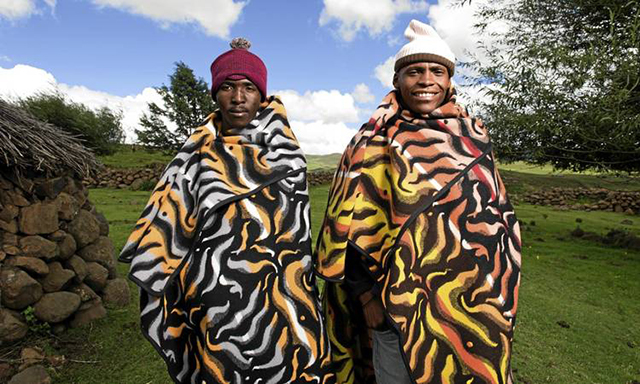
Since the early 1990s, after Frasers was bought out, the blankets have been made in Randfontein by Aranda Textiles. Marketing and sales director Tom Kritzinger started his career with Frasers. Like his father, who sold them, he is an expert on Basotho blankets. He points out that the Victoria England brand is one of the oldest in the world, of the same vintage as Coca-Cola.
Aranda owns what is now the most sought-after brand, Seanamarena. It was introduced by Charles Henry Robertson, the owner of a trading store in the Leribe district, in the early 1930s. Kritzinger says the most popular design in the brand is known as the Chromatic, derived from Robertson's initials CHR.
Kritzinger appreciates the importance of the blankets in Basotho culture: "Blankets are pivotal in their lives. Kobo ke bophelo, the blanket is life. Nothing is more beautiful. The Basotho people are preoccupied with blankets, from birth right through to death every phase is marked by blankets. The baby is received in a blanket, when they go through initiation after puberty there are blankets; when she gets married, the bride is wrapped in blankets and given to the groom.
"Blanket gifts are exchanged between the groom and the bride's family. When a woman is pregnant she cuddles herself into a blanket, symbolising the life that has formed.
"Blankets are used to cover traditional beer. They are interwoven into the fabric of society, and the Basotho are blanket people to the bone."
Kritzinger says although the Basotho blanket originated in England, "over the years it became a tradition that evolved and the Basotho made it unique, that's the beauty of it".
"How they became preoccupied with it and the meaning they have given to it is, for me, the beauty of that culture."Basotho blankets have a number of links to World War 2.
Aranda produces a limited edition of the "Badges of the Brave" blanket, known as the NZ design, which depicts British empire regimental badges from the war, including one with the letters NZ. This has come to be regarded as short for Nazareth, giving it a Christian connotation.
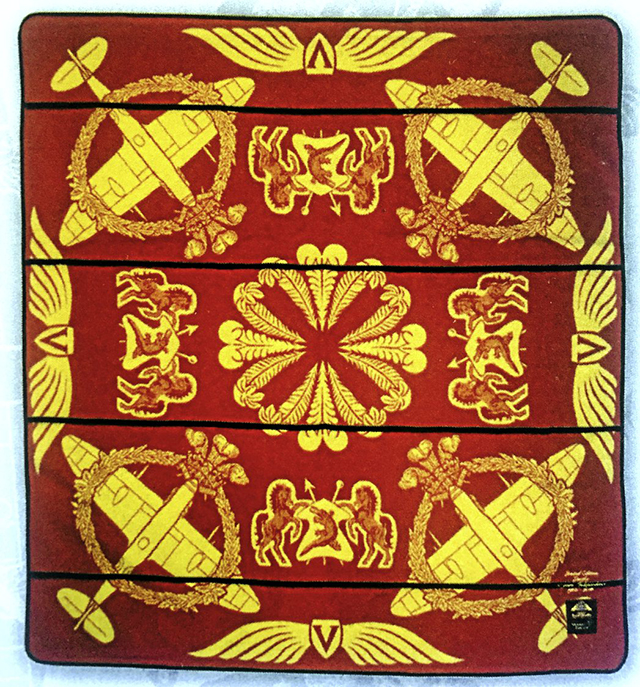
Sometime during or after the war the Spitfire blanket was introduced. The people of Basutoland had collected enough money to pay for 25 Spitfire fighters for the Royal Air Force and they flew as the "Basutoland squadron" in the Battle of Britain. Last year Aranda issued a special limited edition of the Spitfire blanket (pictured above) to commemorate this and Lesotho's 50th anniversary of independence.
Towards the end of the war a textile factory in the Tuscan town of Prato was blown up by Nazi forces as they retreated. The town was liberated by, among others, South African troops under the command of Colonel Arthur Aiken, who persuaded the owners of the textile mill - three brothers - to start again in South Africa. Rodolfo, Giulio and Alberto Magni arrived in 1951 and started Aranda. The mill, still owned by the family, now covers an area equal to 11 football fields and employs more than 700 people.
The Victoria England brand is the only one still owned by AW Hainsworth in the UK, and Aranda has a royalty agreement to manufacture them in South Africa. All the rest were created and owned by Aranda, such as Motlatsi Khosana, created in honour of the birth of Crown Prince Lerotholi Seeiso in 2007. The Kharetsa brand features the spiral aloe only found in the Maluti mountains of Lesotho. Another brand was created in memory of the late Queen Mamohato Bereng Seeiso.
"In the days when I was still with Frasers the late King Moshoeshoe II once called me to the palace in Maseru and expressed his concern that his people were becoming too Westernised," Kritzinger says.
"He gave me some old design ideas, which Queen Mamohato only made popular after his death. There's the Malakabe, using one of the old designs which features flames, and we revived it."
Any new designs introduced have to first have the approval of the Basotho royal family.
Royalties earned from the sale of Victoria England brand blankets are not sent to England but are managed by Aranda purely for the promotion of the brand and to support charities; for example the company has installed or revived 50 "play pumps" at rural schools in Lesotho. These pumps are integrated with playground equipment so that when the children play they also pump water.
"Where some of the pumps fell into disrepair, the schools closed down," Kritzinger says. "We pay rent for advertising boards on the pumps, and that pays for their revival and maintenance."
The blankets are also moving with the times, and are promoted to young people through the royal fashion fair ever year in Lesotho.
"People like Louis Vuitton have looked at them and been inspired," Kritzinger says. "[Fashion designer] Thabo Makhetha in Port Elizabeth has done beautiful work, dresses, capes or jackets, and Unknown Union based in Cape Town has been granted the right to create clothing using the actual blankets. This is a modernisation by younger people who still recognise the beauty of the blankets but want to turn it into a fashion article, and I don't think it's wrong."
At 155cm x 165cm, the blankets are too small to be used as a bed blanket, they are made to be worn. Many people use them as rugs. At 90% wool, they are of the highest quality.

Thanks to the Africa Growth and Opportunity Act trade agreement with the US, Basotho blankets are now being exported and sold there with duty-free status. Some are even sold back to Britain.
THE BLANKET BRANDS THAT DEFINED A CULTURE
Victoria England
The first Basotho blanket brand. It dates to 1897, one of the oldest trademarks around. The Basotho refer to the Victoria England as Lefitori. The collection includes Badges of the Brave, Crest, Crown, Spitfire, Malekable (flame), Skin (the traditional leopard skin) and Pelo ea Morena (heart of the king). Badges of the Brave pays tribute to regiments from the British empire and the Basotho soldiers who served in World War 2.Seanamarena
The crown jewel of Basotho blankets, these date to the 1930s and a store in Leribe. Seanamarena means "to swear by the chiefs". They include Chromatic and Poone, which depicts a maize cob.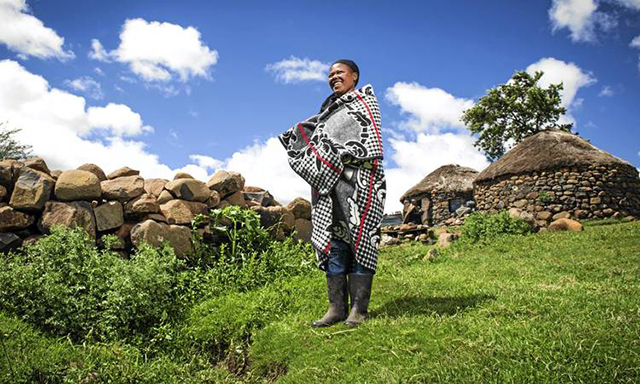
Motlatsi
Created to honour the birth of Crown Prince Lerotholi in 2007. The design displays an elaborate collection of hearts on a houndstooth background. The heart symbolises the love, respect and loyalty that the Basotho nation has for its monarchy. Motlatsi means "successor".Matlama
Less traditional, this features a striking border pattern with a plain reversible centre. Traditionally the fringed version is worn by women during the wedding ceremony. The bound version is worn by men.Kharetsa
This design is (pictured below) named after the spiral aloe which is only found in the Maluti mountains. The aloe is featured prominently in the centre of the blanket and is surrounded by the iconic Basotho hat and Basotho shield.
Named for a home of Britain's queen. Also known as Mohodu after the Sotho word for the inside of an animal's stomach, which it apparently resembles.
The older Motlotlehi wedding blanket no longer exists, and was replaced by the Lingoetsi as a bride's blanket.
Source: http://www.timeslive.co.za/
17 things you didn't know about Lesotho, the world's highest country
1. It just turned 50
Yes, it’s happy birthday to Lesotho, which reaches a half-century of independence today, having shrugged off Britain’s colonial overcoat on October 4 1966. In other words, it has been a sovereign state since just after England won the World Cup. Neither England nor Lesotho has seized football’s big prize since. Which of them will be first to break their dry run? Lesotho are currently ranked 150th best team in the world. Could go either way.
2. It’s land-locked…
In fact, Lesotho is a country within a country, surrounded on all sides by South Africa. Specifically, it lies around 300 miles south of Johannesburg – or 50 minutes by aircraft.
3. …but is in good company
Lesotho is not alone in being unable to see the sea. Africa has more land-locked nations than any other continent – 16 of the 45 members of the planet’s No Coast Gang, in fact.
4. It isn’t big. Sort of
Lesotho is the world’s 137th biggest country, although its 11,720 square miles of territory make it only just smaller than Belgium (which spreads its wings to 11,787 square miles) – and just a little bigger than both Albania (11,100 square miles) and Macedonia (9928 square miles). What is considered large in Europe tends to be viewed as small in Africa.
5. It isn’t big on traffic
Lesotho has one of the world’s smallest road networks – a mere 3,700 miles. Nonetheless, it has witnessed a huge expansion in the last half-century. At the time of independence, the only paved highway was the Kingsway – which linked the royal palace to the airport.
6. It sits in the clouds
There is a good reason for the short road network. Lesotho is very mountainous. In fact, it has the “highest lowest point” of any country. No other nation can claim a base altitude as lofty as Lesotho’s – 4,593ft (1,400m). It is the only independent state on the planet which exists entirely above 1,000m (3,281ft). Hence its apt nickname – “Kingdom of the Sky”.
7. It has a king
Talking of kingdoms, Lesotho is a constitutional monarchy. Letsie III is the guy at the top. He has been on the throne since February 1996 – although he also had a stint in the hot seat from 1990 to 1995, while his father was in exile. He was educated in the UK, at Ampleforth College in Yorkshire. He has three kids, including his heir, Prince Lerotholi.
8. It has only one Unesco site…
But this lack of vaulted company does not diminish the beauty of Sehlabathebe National Park, which was added to the World Heritage list in 2013 as the immediate neighbour of South Africa’s uKhahlamba National Park (which is also in the Unesco club). Together, the pair makes up Maloti Drakensberg World Heritage Site. Sehlabathebe offers steep terrain, Alpine tundra – and 4,000-year-old rock paintings by the ancient San people.
9. …but it may soon have a second
Thaba-Bosiu National Monument has been on Unesco’s “Tentative List” since 2008, and may yet be promoted. Located 15 miles east of the national capital Maseru, in the west of the country, it was here in 1824 that the founder of the Basotho nation, Moshoeshoe I, established a stronghold. He used this rock bluff’s elevation – it rears to some 394ft (120m) above the surrounding countryside – as a defensible fortress in his struggle against the rival Ndbele people. Unesco declares that the site “is valued as the national shrine, and it invokes a sense of identity for the proud nation Basotho.” Watch this space.
10. There are other national parks
Including Ts’ehlanyane National Park, the country’s largest – which spreads out as an elevated expanse of rocky wilderness in the Maluti Mountains. Truly off the beaten track.
11. You can ski there
No, really, you can. Lesotho is home to Afriski (afriski.net), a wintersports enclave – also in the Maluti Mountains – which hits a top altitude of 10,571ft (3,222m). Unsurprisingly, the downhill area is not vast – just a single kilometer-long piste. But it operates during the winter season (June-August) – and is a reasonable 4.5-hour drive from Johannesburg.
12. It has a wonderful waterfall
It may not have quite the height and power of Victoria Falls, but Lesotho’s own grand cascade deserves a few moments of your time. Maletsunyane Falls sees the river of the same name plunge 630ft (192m) near the town of Semonkong. Were it located in a better-known country, this site of splash and crash would be deemed a world wonder. By way of comparison, Niagara Falls – admittedly a harder, faster water feature – dips 167ft (51m).
13. It has a town with the evocative name of “Qacha’s Nek”
This sits on the country’s south-east border (with South Africa, obviously) – and is home to a Snake Park where, if you have the courage, you can see deadly cobras and mambas.
14. Landings can be bumpy…
Lesotho has 28 airports. Only three of them have proper paved runways. Hold on tight...
15. …and take-offs can be terrifying
If you opt to fly from Matekane Air Strip, in the south-west of the country, you may want to have a stiff drink before you step onto the plane, while praying that the crew have been imbibing nothing stronger than coffee. Here are some statistics. The runway is a mere 1,312ft (400m) long. The cliff-face plunge which waits at the end of it stretches to 2,000ft (610m). Cross your fingers, toes, legs and arms – and tell the pilot to put his foot down.
16. Obviously, this means you can fly there
And your best bet is Moshoeshoe I International Airport, the main air hub, which sits in the town of Mazenod, 10 miles south of Maseru. It offers daily flights to Johannesburg.
17. It’s easier to visit than you think
Several respected tour operators offer detailed jaunts around Lesotho. Cox & Kings (020 3811 0608; coxandkings.co.uk) is one of them. Exodus Travels (020 3811 3155; exodus.co.uk) is another.
source: telegraph.co.uk
Saving a cow from Certain Death in the Senqu River
Waking up to the sounds of cow bells ringing on the mountains above our camp was quite a soothing way to start my day, but nothing could prepare me for what was waiting for us on the banks of the Senqu River later that day.
The morning started with a brisk walk to the top of the small mountain we had camped under the previous evening where I located the cow bells were ringing in the distance. They were accompanied by their herdsman walking alongside and towards our camp, wrapped in his traditional Basotho blanket.
By the time I’d finished my walk, he was passing through our camp investigating the stir of activity around one of the old Series 1 Land Rovers because it seems a snake had made it’s way to the engine for warmth, but sadly it found its death as it got fried by the heat and squashed by the bonnet.
The activity from the dead snake awoke the rest of the camp who were still sleeping, and once everyone was awake, ready and fed, we packed up and made our way deeper into this beautiful country that I was falling in love with more and more.
It’s hard not to fall in love with Lesotho with the constant views of rolling mountains, friendly Basotho people and the adventure that comes with the route we were taking through the country. I’ve never actually seen anything quite like it in my life before! You get to the top of one mountain pass, only to find another 3 waiting for you beyond that and then even more beyond those, each with their own breathtaking views from the top and bottom.
We’d been driving for about 5 hours when we decided to stop at the Koma-Koma Bridge for a convoy photo of the Series 1 Land Rovers crossing the old bridge at the bottom of this newly built tarred bridge, which crosses the Senqu River.
Before we could even set-up for the photo though, I saw all the Landies rushing under the bridge and heading out of sight as if they were in a hurry to get somewhere.
I ran down the hill I was on setting up for a time-lapse, only to hear that a group of villagers came running to the convoy asking to help save their cow who had fallen into thick mud on the banks of the Senqu River at around 4am that morning.
Upon my arrival on the scene, Ross Holgate, David Visagie and a group of Basotho Men was already in the mud trying to get tow ropes tied securely around the cow so that the Series 1 Land Rovers could pull the beast out the mud.
It was such a nerve wracking 45 minutes getting the poor cow out of this thick sludge like mud because the more you pull something deep in that mud, the more it sucks it back in again and cows are pretty heavy creatures, averaging around 500kg to 600kg.
It took a few attempts of pulling the cow out of the Senqu River, because we didn’t want top hurt the cow, or get it’s head under the mud because it would then drown. After a few pulls and a heart stopping moment of it’s nose and mouth going under the mud for 3 or 4 seconds, it came out and it was safe!
The villagers all came rushing over after the ordeal and couldn’t thank Kingsley, Ross and the rest of the guys enough. There really is something so special about watching men from different cultures come together to help a helpless animal, which essentially is the Basotho people’s livelihood too.Lesotho was teaching me all sorts of lessons which I’ll treasure for the rest of my life! We eventually got our convoy photo on the old bridge under the Mohlapiso Bridge and off we went even deeper into Lesotho, with a new respect for nature.Up and down we went, left and right, and before long we were on a tar road which took to the top of a mountain pass which looked down onto Africa’s 2nd Largest Dam, the Katse Dam.
We drove around the side of the dam for another hour and a half before we reached another dirt road where we all had to drop into low range to make it to the top where we would camp for the night.
The adventures and events of the day ended with stories around the fire while the sky was occasionally being lit up by lightning in the distance. It wasn’t long before the camp fire died down though and the harmony of snores got louder and louder in the tents around me. It dawned on me as I was lying in my tent that it was my 2nd last night in Lesotho, which left me with mixed emotions as I drifted into dreamland. I didn’t want to leave this place, that was for certain.
Here are a few more shots I snapped during our 3rd Day through Lesotho!
Source: Life of Mike
New Lesotho diamond mine could be a gem
A NEW diamond mine will come into production in Lesotho before the end of 2016, with expectations it too may deliver exceptional gems like its neighbour Letseng, a source of large, gem-quality diamonds. Firestone Diamonds, traded on London’s Alternative Investment Market, will add 1-million carats of diamonds to the global market every year after starting production in October.
The R2.1bn Liqhobong mine is high in the Maluti mountains, and has the potential to become a source of large, gem-quality diamonds, but not as prolific as its neighbour, Letseng. Firestone CEO Stuart Brown, the former chief financial officer at De Beers, estimated about 80% of the value realised from Liqhobong would come from 20% of the mine’s production. Test work showed the mine to be a source of fancy yellow diamonds, he said. Firestone expects to earn an average $130 per carat from its tenders planned for Antwerp in early 2017. Based on test work at a pilot mine that broke large diamonds bigger than 100 carats each, costing up to $25m in lost revenue, there is an expectation the mine will yield special diamonds. The $225m raised in debt and equity would buy a new processing plant that would produce 3.6-million tonnes per annum and deliver large diamonds, Brown said.
The Lesotho government is a 25% shareholder in Liqhobong.
The 15-year life of the mine is calculated on an opencast mine going 393m deep. There is considerable depth to the kimberlite that has yet to be explored.
Gem Diamonds, owner of the Letseng mine, claims its production is the highest average dollar per carat kimberlite mine in the world.
De Beers, the world’s largest producer by value, does not generally tell the market about its large or exceptional diamond production.
The Cullinan mine near Pretoria, once owned by De Beers and now by Petra Diamonds, was the source of a quarter of the world’s large diamonds, Brown said.
Firestone has a market capitalisation of $140m, less than half of its net current value of $379m.
Source: Business Day Live
Lesotho children's centre launch hears Prince Harry speak about losing mother
As Sentebale's £2 million Mamohato Children's Centre was opened in the African nation of Lesotho, Harry movingly described his own experience of bereavement - something many of the children helped by his organisation are living with.
He said the death of his mother Diana, Princess of Wales, in a 1997 car crash, allowed him to empathise with the young orphans he met during his first visit to Lesotho in 2004.
The trip inspired him to set up the charity Sentebale with Lesotho's Prince Seeiso to help youngsters in need and other children who had lost one or both parents to Aids or contracted the disease themselves.
Speaking about the orphans Harry told the guests gathered at the centre's opening ceremony: "They were far younger than me, and of course, their situation was a great deal more challenging than my own.
"Nonetheless, we shared a similar feeling of loss, having a loved one, in my case a parent, snatched away so suddenly.
"I, like them, knew there would always be a gaping hole that could never be filled.
"For so many of the children in Lesotho, that situation was compounded by the harsh environment and extreme poverty they faced. At the age of just eight or nine taking on the responsibility of caring for brothers and sisters there was simply no time for being a child any more."
He added that from that moment "it wasn't a question of when but how quickly could we put something in place which could help these children".
The new centre was opened by Seeiso's brother King Letsie III, Lesotho's monarch, who donated land for the project in the foothills of Thaba Bosiu - a mountain revered as the birthplace of the Lesotho nation.
Harry said: "This centre is now the heart of Sentebale, situated on the hallowed ground of Thaba Bosiu in the country that is our home, Lesotho; it represents how far we have come as a charity but more importantly how much more we want to achieve."
The new facility will allow Sentebale to scale up its Mamohato camps - a residential project that provides psychological, social and practical support to children struggling to cope with being HIV positive.
Harry told the guests, who included Sentebale ambassador Joss Stone who will perform at a private dinner tonight to mark the opening: "The theory of our Mamohato camp is simple - if children have the chance to share with each other how HIV affects them and how they cope with it in a safe and accepting environment, they will lead healthier, more well-adjusted lives.
"Through these camps, children learn about their condition and can then share this knowledge with their peers once they return home."
Harry went on to say: "The Mamohato Children's Centre will enable us to reach many more of these children than has previously been possible. We will increase the number of those attending camps from 400 to 1,500 per year - which represents 29% of our target adolescent group."
King Letsie also spoke at the launch and in a lighter moment joked about the fact Harry is still apparently single.
He made the audience laugh when he said: "I long for the day when I can say Prince Harry and ... I'll have to wait, we'll all have to wait a few years for that."
Towards the end of the ceremony the guests watched a dance troupe from the Sentebale Herd Boys School of Excellence, before Harry, Seeiso and the king joined one of the boys on stage and each received a grey woollen blanket, traditionally worn by Lesotho's Basotho people.
Wrapped in his cloak, Harry, who had been sheltering from the blistering sun under a canopy, joked: "I was starting to feel a bit chilly. Is everyone else warm enough?"
During the launch day for the Mamohato Children's Centre Harry and Seeiso took the King and his wife Queen 'Masenate Mohato Seeiso on a guided tour of the facilities.
Fundraising began for the project in Februrary 2013 and it was completed, under budget costing just over £2 million, in August this year.
It can accommodate up to 96 children and their carers and has a dining hall, medical centre, welcome block and other facilities.
Seeiso said later that Harry told him he had been very impressed when he first saw the completed centre.
The Lesotho prince said: "Prince Harry told me he was just blown away when he first saw it.
"This is the first time he's seem it completed, whereas I have watched it grow week by week."
Seeiso's wife Princess Mabereng-Seeiso, said her husband genuinely valued Harry's friendship.
"They are both second boys and very similar personalities, very cheerful, loving, bubbly and casual," she said.
"They complement each other. A place like this, full of children playing, it reflects these playful personalities.
"The people my husband cares about, it's his brother (King Letsie III) and Harry. And me and the children of course," she added laughing.
During their tour of the centre Harry and Seeiso showed their close bond as they joked with each other and the children.
The pair joined a group of youngster doing a photography workshop taking Polaroids of themselves and sticking them on the wall.
Harry had no qualms about posing with the children and even put on props and did silly poses.
The princes posed in bright sunglasses and Harry even got behind the camera and took a picture of Seeiso in the outlandish glasses.
Source: Dailymail
Useful links
- Official webpage
- http://www.lesotho.gov.ls/
- Ministry of Foreign Affairs
- http://www.foreign.gov.ls/home/
- Lesotho Revenue Authority
- http://www.lra.org.ls/
- Embassy of Lesotho in Berlin
- http://www.lesothoembassy.de/home/
- Embassy of Lesotho in Rome
- http://www.lesothoembassyrome.it/
- Embassy of Lesotho in London
- http://www.lesotholondon.org.uk/
- The Lesotho Highlands Water Project (LHWP)
- http://www.lhwp.org.ls/
- Sentebale
- http://sentebale.org/
- LNDC
- http://www.lndc.org.ls/
- The Kingdom in the sky
- http://visitlesotho.travel/
Downloadable documents
©MMXVI. Medexponet Kft.
